







Overview
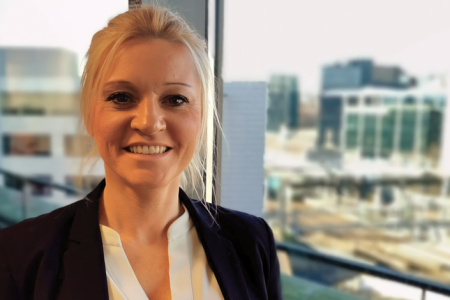
Caroline Lewis, Amey’s Market Director (Wales & Ireland) discusses the broader role stations play in creating thriving, connected communities, and how that thinking is helping shape transport investment and growth across Ireland.
As investment in transport infrastructure gathers pace across Ireland, renewed attention is being given to the role stations play in supporting communities, economic growth and regeneration.
No longer viewed solely as points of arrival and departure, stations are increasingly recognised as catalysts for wider economic and social value. Continually evolving to meet the changing needs of passengers and the demands of the transport industry, they have the potential to transform not only journeys, but the places around them.
This is a mindset that has long shaped Amey’s approach. Working across the full project lifecycle, from stations and rail electrification to digital and data-driven solutions, the organisation helps clients achieve their economic, environmental and social objectives globally and is now bringing that same integrated approach to its growing presence in Ireland
Stations as destinations and drivers of regeneration
“Stations are gateways connecting people to friends, family and jobs, but they are also destinations in their own right,” Caroline Lewis, Amey’s Market Director (Wales & Ireland), said. “If you look at stations such as St Pancras, Manchester Piccadilly and Birmingham New Street, they have become destinations of experience in themselves. Their commercialisation not only encourages customers to spend more time there but also creates additional revenue opportunities for the owners and operators.”
“Beyond that, railway stations can act as anchors for regeneration in the surrounding area. However, to unlock their full potential, transport infrastructure, housing, employment, utilities, public services and digital connectivity must be considered together rather than in isolation, as has often been the case in the past.”
Why connected communities require integrated planning
This place-based approach to infrastructure planning is not new for Amey. It reflects years of work examining how transport, housing, utilities and public services interact to shape communities, including through its Creating Cohesive Communities project. The research initially explored the impact of the COVID-19 pandemic on community infrastructure, with a particular focus on the Cardiff Capital Region.
The study captured insights from nearly 70 organisations across various market sectors, identifying key infrastructure challenges in Wales and the priorities needed to support. This was followed by further work exploring innovative and technology driven infrastructure solutions that help to create a more cohesive community, findings which remain relevant today.
“You cannot plan transport independently of housing utilities, public services, public realm.” Caroline said. “All of these factors influence how places function and how transport networks are used.
“Getting it right can have a transformational impact. Schemes the like the Elizabeth line and the Core Valley Lines Programme (CVL) in South Wales demonstrate the value of taking a wider place-based approach. We have got to think about homes, employment, schools and healthcare, alongside transport investment.”
“The objective is not simply to build homes near transport. It is about creating connected, cohesive communities and understanding what we want those communities to look like, how they will function and the outcomes they need to deliver. Amey has the expertise to make that happen.”
Investment and growth in Ireland
With unprecedented investment planned across Ireland’s transport network, the opportunity to use stations and rail infrastructure as catalysts for wider regeneration has never been greater. Like the country’s housing and economic ambitions, Ireland’s transport investment story is being driven by growth, momentum and long-term potential. It is an opportunity Amey is positioning itself to support as it expands its presence across the island, boosted earlier this year by the opening of a new Dublin office.
For several years the organisation has been working closely with clients and partners across the Irish transport sector, is continuing to grow its team and has already secured numerous contracts and acceptance on several high-profile infrastructure frameworks.
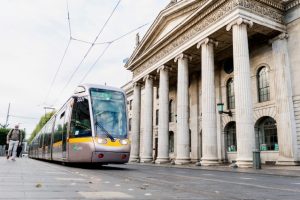
The expertise and efforts are being awarded, with the team at Amey and Keolis securing a contract to operate and maintain Dublin’s iconic Luas light rail system, which successful mobilised on 1 September. That growth is already being reflected in a diverse portfolio of work, spanning urban transport, highways, rail technology and active travel infrastructure. Recent projects include the safety-led redesign of St Brigid’s Junction on the N61 in County Roscommon, an AI-enabled rail wear analysis and reporting solution for the rail industry, and Moylinn Footbridge Replacement project in Northern Ireland.
Building on its early success in Ireland, Caroline believes Amey’s experience of planning and delivering integrated transport and infrastructure programmes positions it well to support the country’s next phase of growth. With major rail investment planned across the island, she sees a significant role for the business in helping clients deliver infrastructure that supports thriving, connected regions.
Delivering Ireland's next phase of transport investment
Central to that proposition is Amey’s ability to combine consultancy, delivery and operational expertise throughout the asset lifecycle.
“Amey is a both a developer and an operator. We do not just design infrastructure, we understand how it is delivered, operated and maintained throughout its life” Caroline said. “That means we bring real operational insight to our clients, whether through systems integration, maintenance delivery, asset management or whole-life performance optimisation.
“The opportunity to lean into those strengths, particularly in areas such as railway electrification, smart infrastructure, asset digital resilience. These are the sectors where our operational expertise and technology capability create the greater value for clients.”
There is real excitement around the opportunities across the Republic of Ireland. While there will undoubtedly be challenges with half a dozen major projects coming under construction in Dublin at any one time, alongside significant programmes such as Cork Docklands, Luas expansion, DART+, and developments in Limerick, the scale is unprecedented.
Infrastructure as a catalyst for long-term growth
The expertise of a global infrastructure consultancy and operations partner designing, delivering, protecting and maintaining critical assets and systems is matched by a passion from creating thriving places. We know that when transport is planned and delivered well, it supports more connected, vibrant and prosperous communities.
“For passengers, our job is to make journeys simpler, more reliable and more attractive, so we work closely with our clients to make that happen.” she said. “We look at innovations, be it digital solutions or partnerships with SMEs that can enhance passenger experience, encourage people to return to rail and ultimately increase patronage for operators.
“Whether that creates new leisure markets attracts more visitors or generates additional non-fare revenue alongside fare income, it is exciting to see the wider impact that investment can have.” She said, “If you get it right, the long-term social and economic benefits are significant, which is why I believe Ireland will see real value from the investment being made.”
Caroline also believes there is much to learn from schemes that have successfully translated infrastructure investment into wider social and economic benefits. One example is the Core Valley Lines programme in South Wales, where Transport for Wales commissioned Amey to transform the railway network serving communities across the Valleys. The project involved electrifying 170km of track, upgrading stations and signalling, and building several new stations to create a metro-style rail network. By improving connectivity between people, places and opportunities, it demonstrated how rail investment can support regeneration, strengthen regional economies and unlock long-term growth. “A project like the Core Valley Lines in South Wales creates opportunities for people by improving access to employment, housing and essential services,” she said. “It makes it easier for people to get to work, supports economic growth and helps communities thrive. Ultimately, when you get transport right, economies grow and people enjoy a better quality of life.”
“Property and Land values increase where high-quality transport is available. The Bee Network in Greater Manchester and the Elizabeth Line in London excellent examples of the wider benefits that investment in rail and integrated transport can deliver, alongside the increases in passenger numbers these schemes have helped to deliver.”
Creating places that thrive
The importance of looking beyond the asset itself is a principle that has shaped Caroline’s approach throughout her career. One example that continues to inspire her comes from her time working in the Middle East, where she was involved in the development and supervision of the construction of the Burj Khalifa in Downtown Dubai, the world’s tallest building.
“The Burj Khalifa, like a railway station, does not thrive in isolation. Its success comes from everything that has been created around it” she said. “What I enjoy most is seeing a vision move from design, to construction, and ultimately to the infrastructure, economy and community that thrives around it,” she said.
“The Burj Khalifa is one of the best examples I have seen of that approach working in practise. It is probably one of the busiest places in the world, combining retail, leisure, tourism and excellent connectivity through the metro network.”
“At times the journey to deliver these projects can feel challenging, especially for the public who have to live with the disruption, but when the work is complete that end result is so powerful. Seeing not only the completed development but the wider regeneration, jobs, economic activity, housing, social benefits it creates, demonstrates how transformative infrastructure can be. It becomes a catalyst for growth.”
And Caroline hopes to use her own experiences and that of the wider Amey team to have a similar impact on the future of Ireland.
“I believe the investment in Ireland has the potential to make a significant difference to individuals, communities, and the wider economy if it is planned and delivered in the right way,” she said. “We are listening carefully to our clients and thinking about how we build the right partnerships on the ground to help turn their ambitions into practical deliverable projects and sustainable places to live and work.
“I hope in years to come we will be able to look back with pride at the places we have helped shape and the transport networks and stations that have helped those communities prosper.”
This was first published in Rail Director in September 2026.