








Key metrics
0
tonnes CO₂e saved across live trials
0
carbon reduction in material trials
0
of road network enabled for decarbonisation
Supporting North Lanarkshire Council’s Centre of Excellence for Decarbonising Roads: how Amey is helping turn live trials into practical, low‑carbon highways services
Local authorities and infrastructure operators are under pressure to reduce carbon emissions from road construction and highways maintenance, while maintaining safety, performance and cost control.
The barrier is not innovation. It is trusted, comparable evidence that low carbon materials work under real traffic, within live delivery conditions and existing operational constraints.
Through the ADEPT Live Labs 2 programme, Amey supported North Lanarkshire Council and programme partners in establishing the UK Centre of Excellence for Decarbonising Roads. This created a structured, real world framework for testing, validating and scaling low carbon road materials.
By generating evidence in operational environments—and translating it into a format aligned with procurement and delivery decisions—the programme enables infrastructure owners to move from isolated trials to confident, scalable adoption.
Live Labs 2 builds on the success of Live Labs 1, bringing together seven local authority led projects across four interconnected themes.
At a glance
- ADEPT Live Labs 2 is a three-year, £30 million Department for Transport programme bringing together seven projects across four themes to help decarbonise the UK’s 396,000km local road network.
- Extended to March 2027, with an additional £300,000 of DfT funding, the programme is now focused on sharing insights, evidence and innovations to support sector-wide adoption and scale-up.
- This work addresses a consistent global challenge on how to adopt low carbon materials without increasing delivery risk. Amey is working as a delivery partner to support live trials, comparative testing and the sector’s first Knowledge Bank for low carbon highways.
- The UK Centre of Excellence for Decarbonising Roads is a two campus model, where materials innovation and live supersite trials are led by North Lanarkshire Council (North campus). Transport for West Midlands leads on trials and skills development (South campus).
Overcoming evidence and confidence barriers in low carbon highways maintenance
Road materials alone contribute around 40 percent of highways sector emissions, yet opportunities to trial low carbon alternatives safely are limited. Without consistent evaluation methods or shared data, local authorities lack the confidence to adopt new approaches through procurement at scale.
Evidence is often generated in controlled environments, using inconsistent methodologies. This makes it difficult for local authorities to compare materials or understand true operational performance.
The result is a gap between innovation and adoption. New materials are developed, but not taken forward into specifications or programmes.
This is not only a technical issue. It is a decision-making challenge. Without clear, comparable and operationally relevant data, infrastructure owners cannot justify change at scale.
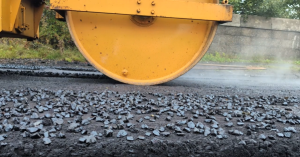
Proving low-carbon highways maintenance through live trials and scalable delivery
To address the lack of confidence holding back low carbon highways maintenance, Amey and its partners focused on proving what works in the real world and making it easy to adopt. That thinking underpinned the Live Labs 2 approach, shaping how evidence was generated and applied.
Evidence was therefore built where delivery decisions are made. On live networks. Under real traffic. Within existing operational constraints. Through close collaboration between Amey, local authorities, supply chain and delivery partners, insight was translated into practical action that councils could trust and apply with confidence.
Alongside live trials, Amey supported work to remove the practical barriers that slow adoption. Behaviour change research explored how councils assess risk and make procurement decisions, while innovation sandboxes supported small and medium sized enterprises (SMEs) to develop and test low carbon materials in a live, low risk environment. This ensured that innovation could move beyond pilots and into business as usual delivery.
This approach was delivered through a connected set of actions:
- As delivery partner, Amey helped establish a national evidence base through the UK Centre of Excellence for Decarbonising Roads, creating a consistent framework for testing low‑carbon materials under live traffic conditions.
- Amey worked with North Lanarkshire Council to deliver live comparative trials at the UK’s first highways supersite, assessing carbon performance alongside durability and constructability to ensure results were credible for everyday highways maintenance.
- Adoption and scale were addressed, combining behaviour change research, procurement insight and operational models to remove barriers to embedding low‑carbon solutions in highways services.
- Shared learning at pace was enabled through the launch of the sector’s first Knowledge Bank, giving local authorities access to verified carbon data, trial evidence and practical case studies.
- Delivery brought together multidisciplinary teams across Amey, combining consulting insight, engineering validation, carbon analysis and live network delivery. This integrated approach reflects how Amey connects expertise across the asset lifecycle to move from innovation into practical highways delivery.
As Kyle Clough, Highways and Waste Collections Sector Director at Amey, explains:
“Live Labs 2 has shown what’s possible when innovation is tested in the real world. By working closely with North Lanarkshire Council and partners across the programme, we have helped turn research and insight into practical delivery. The tools, evidence and networks created through this work will continue to support the highways sector long after the programme concludes.”
As a result of this work, local authorities gained the evidence and confidence to change how highways maintenance is delivered.
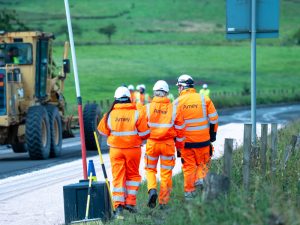
Measurable carbon reduction and a replicable model for highways services
The UK Centre of Excellence for Decarbonising Roads has delivered tangible carbon savings, alongside a step‑change in how low‑carbon highways maintenance can be tested, adopted and scaled.
- Across the UK Centre of Excellence for Decarbonising Roads project, more than 100 tonnes of carbon dioxide equivalent (CO₂e) were saved through live trials, demonstrating real‑world carbon reduction achieved through delivery rather than modelling alone
- Comparative materials trials at the UK’s first highways supersite achieved up to 58 percent carbon reduction, providing robust, like‑for‑like evidence to support procurement and specification decisions
- At a national level, the Knowledge Bank has been developed through the UK Centre of Excellence for Decarbonising Roads. It has helped local authorities compare materials, understand carbon impacts and make more confident procurement decisions.
- As a result, the national Live Labs 2 project has been recognised through major industry awards, including the Highways UK Net Zero Award, DfT Special Recognition Apprenticeship Award and multiple RSTA honours, alongside a one‑year extension to support national dissemination.
By connecting evidence, delivery and people, this work shows how better decisions lead to safer, lower‑carbon highways that communities can rely on every day. This approach provides a foundation for future programmes, where consulting, engineering and operational delivery are integrated from the outset to accelerate decarbonisation at network scale.
Delivering ten strategic innovations and a portfolio of practical solutions, ADEPT Live Labs 2 is helping local authorities cut carbon, improve efficiency and make smarter decisions across the highways lifecycle. The programme’s ambition is to embed low-carbon thinking into everyday highway management.
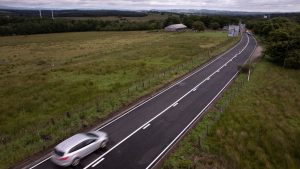
Testimonial
“Live Labs 2 is about pushing ourselves to achieve net zero. The Centre of Excellence brings together local authorities, industry, and academia to tackle the decarbonisation of our roads. At North Lanarkshire Council, we’re proud to lead the North Campus, trialling innovative materials and methods that could shape the future of local roads. Through the Centre of Excellence model, we’re creating a collaborative space to share knowledge, break down silos, and scale what works across the UK.”