








Key metrics
51
EVs deployed
100%
fleet electrification
18%
increase in EV adoption
Overview
Can electric vehicles operate reliably across some of the Defence estate’s most remote locations?
That was the challenge facing the Central and North Regional Accommodation Maintenance Services (RAMS) contracts as the Defence Infrastructure Organisation (DIO) responded to wider government requirements to decarbonise public sector vehicle fleets.
Supporting accommodation maintenance and facilities management services across a geographically dispersed estate, the fleet needed to operate in locations where charging infrastructure was often limited. At the same time, an ageing diesel fleet was becoming increasingly costly to maintain and less reliable in service.
Working with Ford and Novuna, we delivered a fleet transformation programme that introduced electric vehicles across the contracts, supported by improved charging access and data-led fleet management. The programme achieved full fleet electrification while continuing to meet the operational requirements of the Defence estate.
At a glance
- As the Ministry of Defence worked towards decarbonising its non-operational “white fleet”, the RAMS contracts provided an opportunity to support wider government objectives.
- With the existing diesel fleet becoming increasingly costly to maintain, a modern and more reliable replacement was needed.
- A partnership with Ford and Novuna enabled the rollout of electric vehicles equipped with telematics, enhanced safety technology and branded livery.
- Concerns about charging accessibility, particularly in northern locations, led to the adoption of the Allstar national charging network.
- By bringing together vehicle renewal, charging access and operational insight, the programme established a practical approach to EV adoption in a complex working environment.
Balancing decarbonisation targets with operational demands
The transition aligned with wider UK Government fleet decarbonisation goals, including the requirement for central government departments and arm’s-length bodies to operate a fully zero-emission car and van fleet by the end of 2027. As the MOD worked towards decarbonising its non-operational ‘white fleet’, contractors were expected to move away from diesel and petrol vehicles.
For the RAMS contracts, the challenge extended beyond vehicle replacement. The ageing diesel fleet was becoming increasingly repair-heavy and costly to maintain, but teams also worked across widely dispersed Defence sites where access to charging infrastructure varied.
Drivers in the North had reported a lack of available chargers. Without a broader and more dependable network, the move to electric vehicles could have affected confidence, journey planning and the continuity of essential services.
The task was to introduce a compliant electric fleet that remained practical for frontline teams working across the estate.
For teams working across geographically dispersed locations, the transition also introduced a new operational consideration: how charging could be accommodated within the working day without affecting service delivery. While charging-time data is not currently available, understanding how colleagues plan charging around their workload and journeys is an important part of assessing the practical impact of EV adoption.
Building the conditions for successful EV adoption
We designed and delivered a complete fleet transformation programme, addressing the vehicles, charging access and operational information needed to make the transition practical.
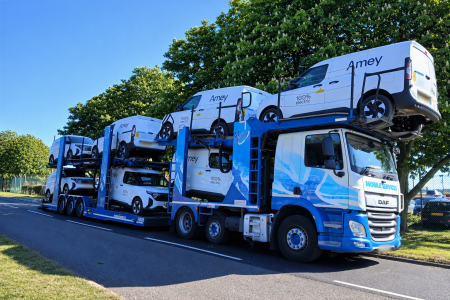
Working closely with Ford and Novuna, we procured 51 electric vehicles. Each vehicle was fitted with branded livery, telematics and enhanced safety technology before deployment, ensuring it was ready for operational use from day one.
We brought together expertise from Fleet Management, environmental, social and governance specialists, regional operational teams and commercial partners. This collaborative approach helped ensure the solution met DIO’s sustainability requirements while reflecting the realities of work across the Defence estate.
Charging access was particularly important for teams operating across more remote and geographically dispersed locations. Feedback from drivers in the North highlighted limited charger availability as a practical barrier to EV adoption. In response, we moved to the Allstar national charging network, widening access to charging points and giving teams greater flexibility when planning journeys across the Defence estate.
Telematics provided better visibility of vehicle use and performance, supporting safer and more efficient operations. Together, these measures created a contract-aligned solution designed around the needs of operational teams rather than treating vehicle procurement as a standalone exercise.
A fully electric fleet built for service
The programme replaced every diesel van across the Central and North RAMS contracts, delivering a fully electric fleet while maintaining the services Defence customers depend on.
- Newer vehicles reduced maintenance pressure and the risk of breakdown-related disruption.
- The Allstar network widened charging access for colleagues working across dispersed and remote locations.
- Telematics gave operational teams better information about vehicle use and performance.
- The transition reduced local emissions and supported cleaner, quieter environments for Service personnel and their families.
- The 51 RAMS vehicles increased EV adoption across the wider Complex Facilities fleet by 18%, contributing to broader business decarbonisation goals.
The programme supports DIO’s wider priorities around estate sustainability, asset performance and reliable service delivery. It demonstrates that fleet decarbonisation can be achieved in a complex operational environment when vehicle technology is introduced alongside suitable charging access and data-led management.
The programme also shows how electric vehicles can be introduced successfully across geographically dispersed and operationally demanding estates.