













Overview
The government continues to invest billions in infrastructure, while operators face increasing pressure to deliver more value from every pound spent. Yet some of the biggest opportunities to improve outcomes are won or lost long before construction begins.
The sector rightly focuses on funding, delivery and engineering excellence. These remain critical. But there is another factor that receives far less attention despite its potential to influence every stage of the asset lifecycle: customer insight.
Too often, customer experience is viewed through the lens of communication, helping organisations explain decisions once they have been made. Its greatest value, however, may lie much earlier in the process.
The organisations creating the greatest public value are increasingly those that recognise customer insight as more than a service function. They understand that customer understanding can shape investment decisions, influence design choices and improve long-term outcomes before a single spade hits the ground.
Better decisions create greater public value
The public does not experience contracts, organisational structures or delivery models. A road user experiences their journey. A rail passenger experiences reliability. A resident experiences the impact of disruption in their community.
Yet many of the decisions that shape those experiences are made long before a customer receives a project update, sees a road closure notice or encounters works on the ground.
Investment priorities, design choices, maintenance strategies and accessibility considerations all influence customer outcomes. That distinction changes the conversation. Rather than asking, “How do we communicate this decision?”, organisations should first ask, “How can customer insight help us make a better decision?”
Success is increasingly measured not by what infrastructure delivers, but by the value it creates for people and communities. Customer insight helps organisations understand those outcomes before delivery begins.
We have seen the value of this approach in practice. Through the Core Valley Lines programme, Amey helped transform the railway network connecting communities across the Welsh Valleys. Reduced journey times, increased service frequencies and more sustainable infrastructure were all important, but they were never the end goal. The programme was designed around outcomes, making it easier for people to access jobs, education and services while continuing to live in the communities they called home. Success was measured not only by what was built, but by what became possible because it had been built.
This is the difference between treating customer experience as an outcome and using it as a decision-making tool.

Customer focus is an efficiency strategy
When budgets are tight, customer activity can sometimes be viewed as an additional cost. In reality, customer-centred thinking often prevents unnecessary expenditure.
Poorly coordinated works can create repeated disruption and additional costs. Designs that fail to consider accessibility, maintainability or operational requirements frequently require expensive modifications later. Defects that result in repeat interventions consume labour, materials and valuable access opportunities.
These should not be viewed as separate technical, commercial and customer challenges. More often, they are different symptoms of the same issue: decisions that fail to consider the whole outcome.
By understanding customer needs earlier, organisations can reduce rework, minimise disruption and target investment more effectively. They can also avoid transferring costs into the future, where they often become significantly more expensive to address.
The lowest-cost option is not always the best-value option. True value for money is achieved when investment delivers the greatest sustainable benefit over the life of an asset.
As pressure to do more with less increases, customer insight should be viewed as a strategic input to decision-making, not a cost of delivery.
Customer insight is a strategic asset
One of the biggest opportunities for the sector is using customer intelligence earlier in the decision-making process.
Too often, customer feedback is collected after delivery, when key decisions cannot easily be changed. The real value lies in moving that intelligence upstream and using it to inform strategy, investment planning, option selection and design.
This is where Amey’s whole-life perspective brings particular value. We do not simply advise on infrastructure. We help design, deliver, operate and maintain it. That means we see first-hand how decisions made during planning and procurement continue to influence operational performance, resilience, maintenance costs and customer outcomes years after construction has finished.
By combining customer insight with asset management expertise, advanced analytics, scenario modelling and operational experience, we help clients make decisions that balance performance, risk, resilience and customer outcomes.
Better decisions require customer insight, technical expertise and operational experience to be considered together.
Our work across highways, rail, public estates and energy infrastructure provides access to a broad evidence base and allows lessons learned in one sector to inform challenges in another. While the environments may differ, many of the customer priorities remain remarkably consistent: reliability, accessibility, safety, resilience and value.
The real value of customer insight lies not in explaining decisions, but in shaping them.
Embedding customer thinking into organisational culture
For customer insight to influence decisions, it must be embedded into strategy, delivery, performance measures and accountability.
At Amey, our Customer Strategy is built around understanding customer needs, improving reliability, generating meaningful insight, recognising diverse customer requirements and developing customer capability across the organisation. Customer objectives are reflected in contract performance measures and embedded into employee objectives, creating accountability for outcomes.
This is critical because if customer experience is everyone’s responsibility, but nobody is measured against it, it risks becoming nobody’s priority.
Our customer training programmes help colleagues understand how the decisions they make influence customer outcomes, whether or not they interact directly with the public.
The principle is straightforward; every role and every decision has a customer consequence.
This is particularly important when considering inclusion. There is no such thing as an average infrastructure user. The needs of a disabled traveller, an older passenger, a freight operator, a business owner and a local resident can differ significantly. A solution that works well for one group may create barriers for another.
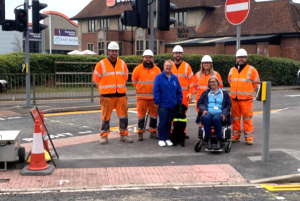
On our Staffordshire I+ contract, colleagues walked an active traffic-management route alongside a local guide dog user and Guide Dogs, gaining first-hand insight into the barriers faced by blind and partially sighted pedestrians. That experience is shaping how teams plan and deliver temporary traffic controls, turning accessibility from a compliance requirement into a decision-making tool.
That is why inclusion must be considered during decision-making, not simply addressed through communications afterwards. Infrastructure designed with diverse needs in mind is often more resilient, more effective and more sustainable in the long term.
Inclusive infrastructure is simply better infrastructure.
The customer dividend
The next chapter of infrastructure delivery will be defined by more than engineering excellence alone. Success will belong to organisations that effectively combine technical expertise, operational knowledge, customer insight and strategic thinking.
As the sector faces increasing pressure to deliver greater value from limited resources, the opportunity is clear. We must move beyond listening to customers and start using customer insight to shape decisions from the outset.
Ultimately, success should not be measured by the size of a funding announcement or the number of projects approved. It should be measured by the outcomes infrastructure creates for people, places and the wider economy.
The organisations creating the greatest value will be those that use customer insight before decisions are made, not simply to assess their impact afterwards.
Customer insight has a critical role to play in achieving those outcomes. Not simply by helping organisations explain what they are doing, but by helping shape what they do and why.
That is the customer dividend; better decisions, better delivery and greater value from every pound invested.