








Overview
Ireland’s housing crisis is rarely out of the headlines. Almost every discussion about the country’s future eventually returns to the same question: how do we build more homes?
It’s an important question, but perhaps not the most important one.
What if Ireland's housing crisis is not really a housing crisis at all?
In many ways, the pressures facing the country’s housing market are a symptom of success. A strong economy, sustained inward investment and a growing population have created demand that supply has struggled to keep pace with, while cities and regions across Ireland continue to attract businesses, jobs and talent. These are challenges, certainly, but they are also the by-product of a country with ambition, momentum and enormous potential.
At the same time, the Government has committed to delivering 300,000 new homes by 2030 through the National Development Plan, while housing completions are forecast to reach around 40,000 homes in 2026, with demand still expected to outstrip supply. These figures highlight the reality that housing delivery alone is unlikely to provide a complete answer. Alongside building new homes, Ireland must also ensure that it is supported by the transport, infrastructure and services needed to help communities prosper.
Viewed through that lens, Ireland’s housing challenge looks less like a shortage of homes and more like a question of how growth is distributed across the country. The real question is not simply whether Ireland can build enough homes, but whether enough people can access opportunity.
A house is only part of the equation
Imagine two towns. One has affordable housing and significant development potential, while the other has the jobs. If travelling between them is slow, unreliable or impractical, they remain disconnected from one another regardless of how many homes are built.
People instinctively understand this. When deciding where to live, housing is only one consideration; access to employment, schools, healthcare, transport and wider opportunities often matters just as much. Businesses think in similar terms, with access to talent frequently proving as important as access to property.
This is why housing and connectivity should never be viewed as separate challenges. A home creates a place to live, but connectivity creates access to opportunity, and the two are inseparable.
That reality is becoming increasingly important in Ireland. While Dublin continues to act as a major economic engine, cities such as Cork and Limerick are attracting investment, talent and growth of their own. The opportunity is not simply to build more housing, but to create more places where people can realistically choose to live, work and thrive. Achieving that requires investment that connects people to opportunity wherever they choose to call home.
Rail changes the geography of opportunity
Transport discussions often focus on infrastructure: new lines, new stations, additional services and increased capacity. Yet the real value of rail is not the infrastructure itself, but the role it can play in shaping how and where growth happens.
Rail has a unique ability to connect cities, towns, businesses and communities, helping to unlock development beyond traditional economic centres and supporting more balanced regional growth. In doing so, it creates the conditions for investment, skills and opportunity to spread further across the country.
That is one of the reasons connectivity sits at the heart of Project Ireland 2040, the Government’s long-term strategy for balanced regional development. The ambition is not simply to accommodate growth, but to shape where growth happens and ensure its benefits are felt more widely across Ireland.
Projects such as DART+, which will significantly expand and modernise Dublin’s electrified commuter rail network, demonstrate how seriously Ireland is investing in that vision. Yet the greatest benefits of programmes like these are unlikely to be measured purely through passenger numbers or journey times. Their true value lies in the communities they connect, the businesses they support and the opportunities they unlock.
We have seen this before.
Wales showed what happens when connectivity comes first
If this sounds familiar, it is because similar challenges have been faced elsewhere.
In South Wales, economic opportunity was concentrated around Cardiff, while many communities in the Valleys remained less connected to that growth than they could be. Rather than treating transport as an isolated challenge, the focus was on strengthening connections between people and opportunity.
Through the Core Valley Lines programme, Transport for Wales commissioned Amey to help deliver a transformation of the railway network connecting communities across the Welsh Valleys. The ambition stretched far beyond transport. Reduced journey times, increased service frequencies and more sustainable infrastructure were all important, but they were never the end goal.
The objective was to make it easier for people to access jobs, education and services while continuing to live in the communities they called home. In other words, the programme was designed around outcomes rather than assets.
Success was measured not only by what was built, but by what became possible because it had been built. The experience demonstrated a simple but powerful lesson: connectivity can unlock growth far beyond the railway itself.
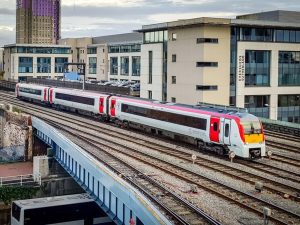
One of the most important lessons from programmes such as Core Valley Lines is that successful infrastructure projects are rarely about infrastructure alone. Railways do not drive growth in isolation, nor do housing developments, utilities networks or economic policies. Lasting growth happens when these elements are brought together around a common objective and aligned behind a shared vision for communities and regions.
This is where infrastructure delivery becomes less about individual projects and more about understanding how complex systems interact.
At Amey, this is the perspective we bring to infrastructure challenges. As a systems integrator, our role is not simply to deliver assets, but to bring together planning, engineering, operations, technology and long-term asset management around a shared outcome. Because the most successful projects are rarely defined by what they build; they are defined by what they enable.
For Ireland, that distinction matters. As investment continues through Project Ireland 2040, the challenge will not simply be delivering housing, transport and infrastructure projects successfully as individual schemes, but ensuring they work together to achieve broader social and economic ambitions.
The real prize
If there is one point worth repeating, it is that Ireland’s future growth will not be shaped by housing alone, or by infrastructure alone. It will be shaped by how effectively those investments work together. That is where systems integration becomes critical.
For Amey, this is an exciting moment. We have seen across Wales, the UK and internationally how transport investment can unlock opportunity, strengthen communities and support long-term growth when it is delivered as part of a wider vision.
As Ireland enters its next phase of development, we look forward to bringing that experience and expertise to the market, helping ensure housing, transport and infrastructure work together to create lasting value for the communities and regions they serve.